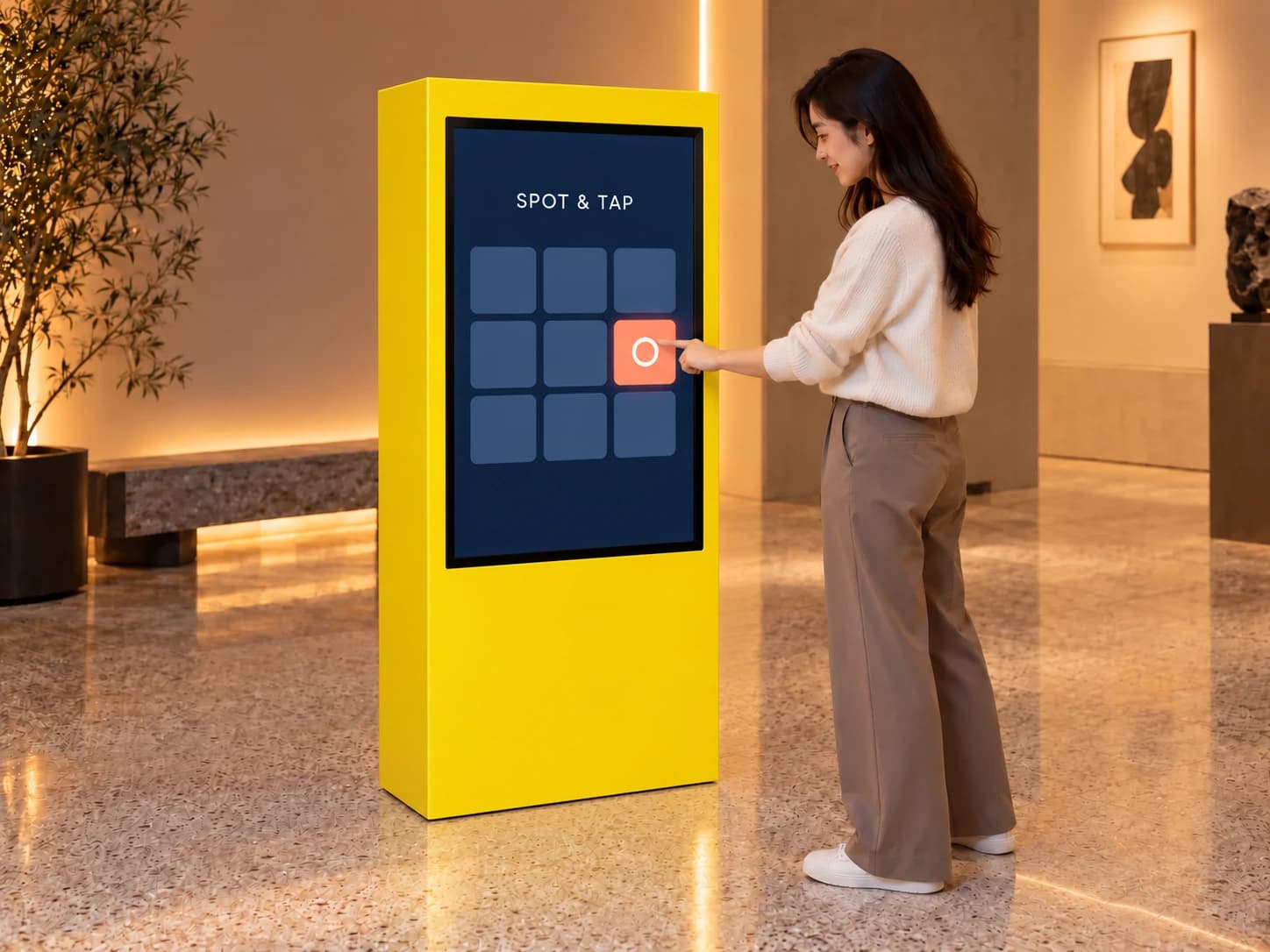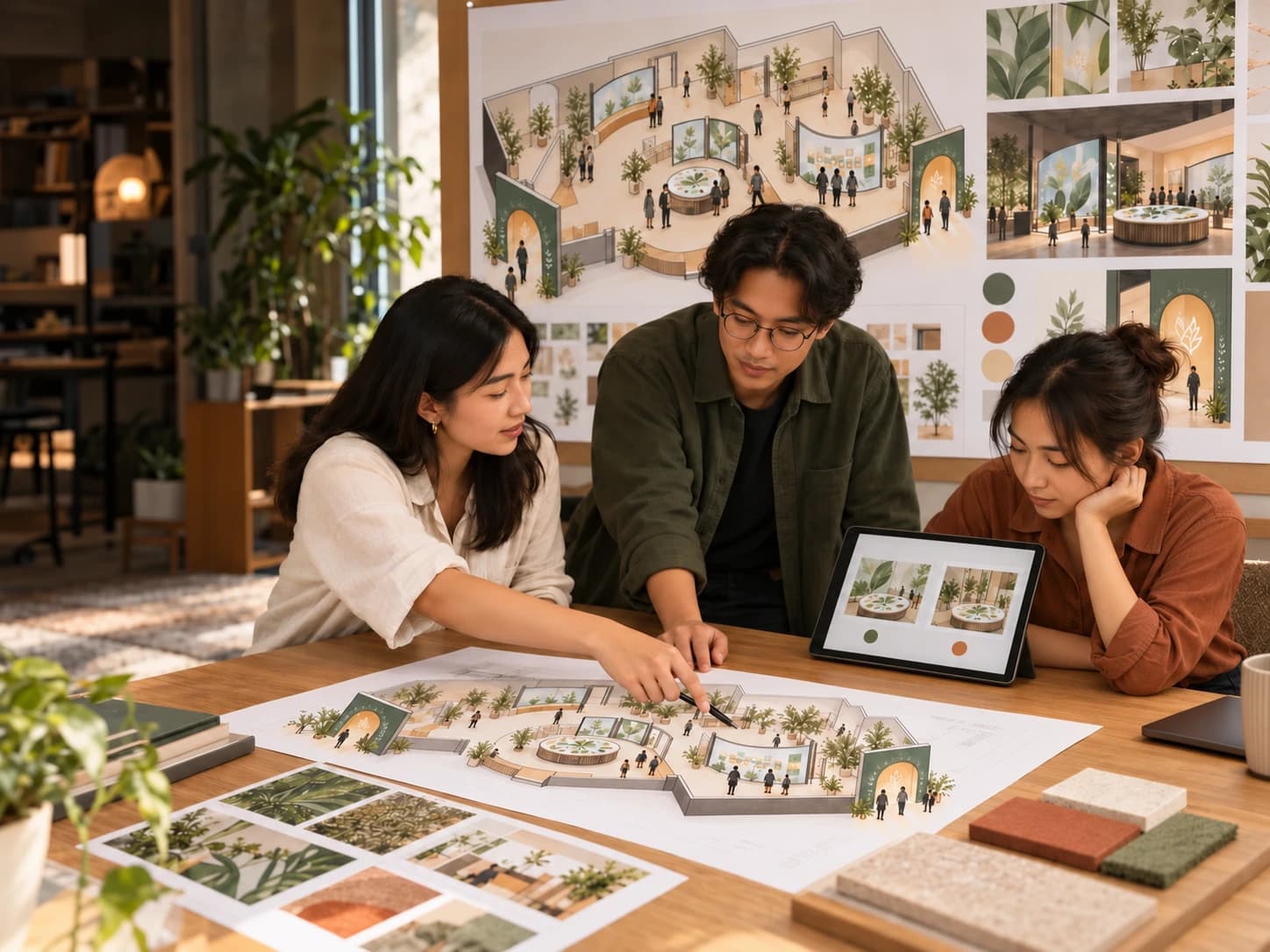

Consider three briefs that could all land on a designer’s desk as “we need a touchscreen game”. An airline has a fare worth a second look. A jeweller wants to invite shoppers into a boutique. A supplier needs buyers to understand a range of technical services. Order the kiosk first and the briefs sound remarkably similar. Describe what a visitor should do at each one and they lead to three different games.
When we plan an advertising game, we write down the action that carries the message. To communicate a price, ask someone to guess it. To invite a passer-by to play, give them a move they can understand by watching someone else. To explain a service, let a prospective buyer work out which problem it solves. Here’s how each choice played out in an Infinity Core project.
Scoot turned a fare reveal into a quiz
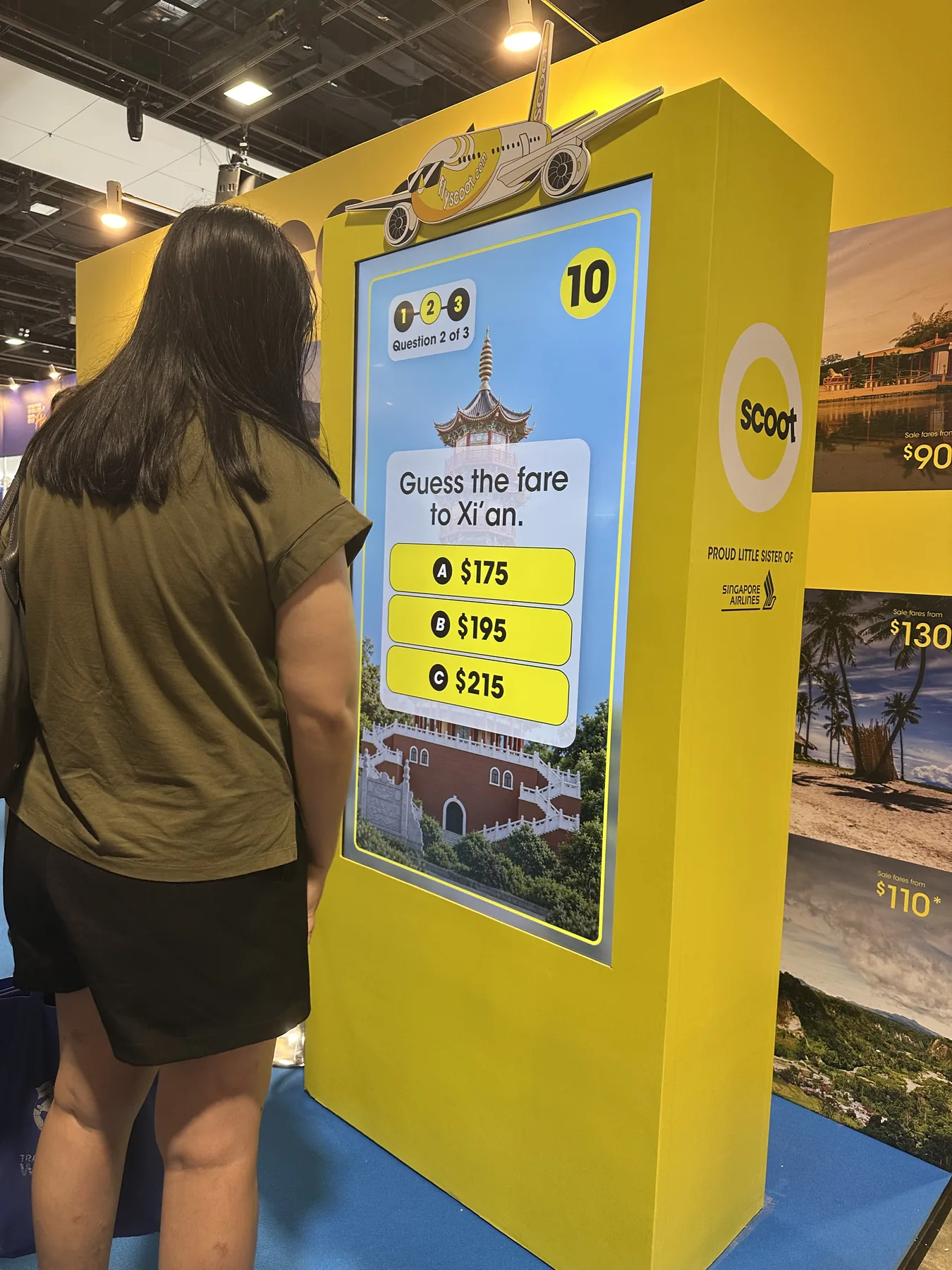
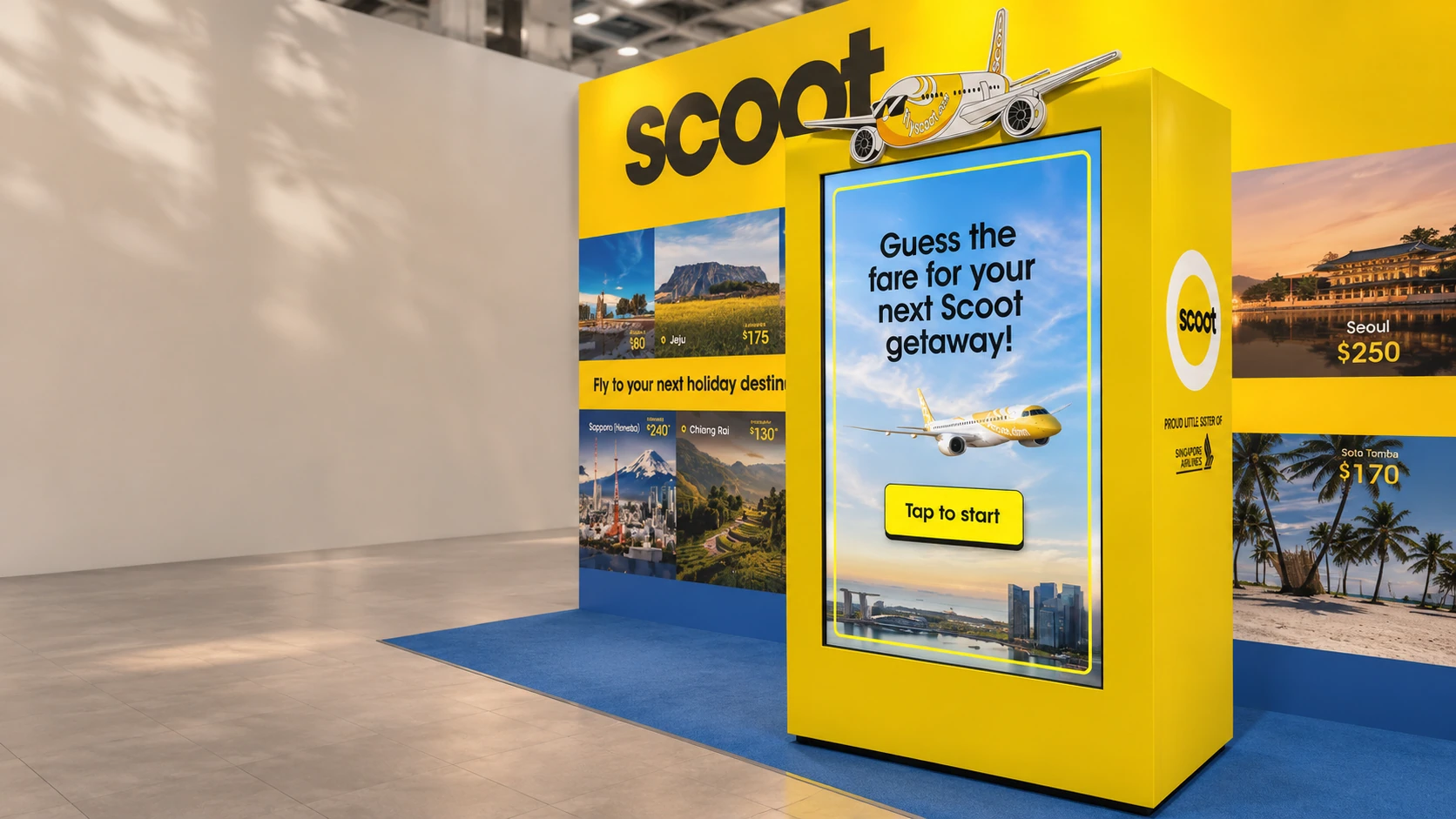
Scoot had an offer almost anyone could understand at a glance. That was also the challenge. Someone walking past a price board could take in a destination photograph and a dollar figure without ever considering the trip. The yellow touchscreen quiz kiosk at Scoot’s booth in Singapore put the visitor’s own expectation into the offer.
The screen showed a destination and three possible fares. As the countdown ran, the visitor had to decide what they thought that trip would cost. A tap brought up immediate feedback and revealed the advertised fare. After three destinations, the kiosk showed a score out of three and reset for the next player.
The small but important decision was when to show the price. Moments earlier, the visitor had put a figure on that very journey. The fare now meant something in relation to their guess. Even the answer they got wrong did the job Scoot needed the game to do.
For a campaign built around an offer, try writing the reveal first. What would someone be glad to discover while waiting for a friend at your booth? If the answer could change which destination they consider or which product they pick up, it’s a good candidate for a quiz. Keep the explanation close to the guess, while the player still remembers why they chose it.
Lee Hwa’s Diamond Drop made sense from the queue
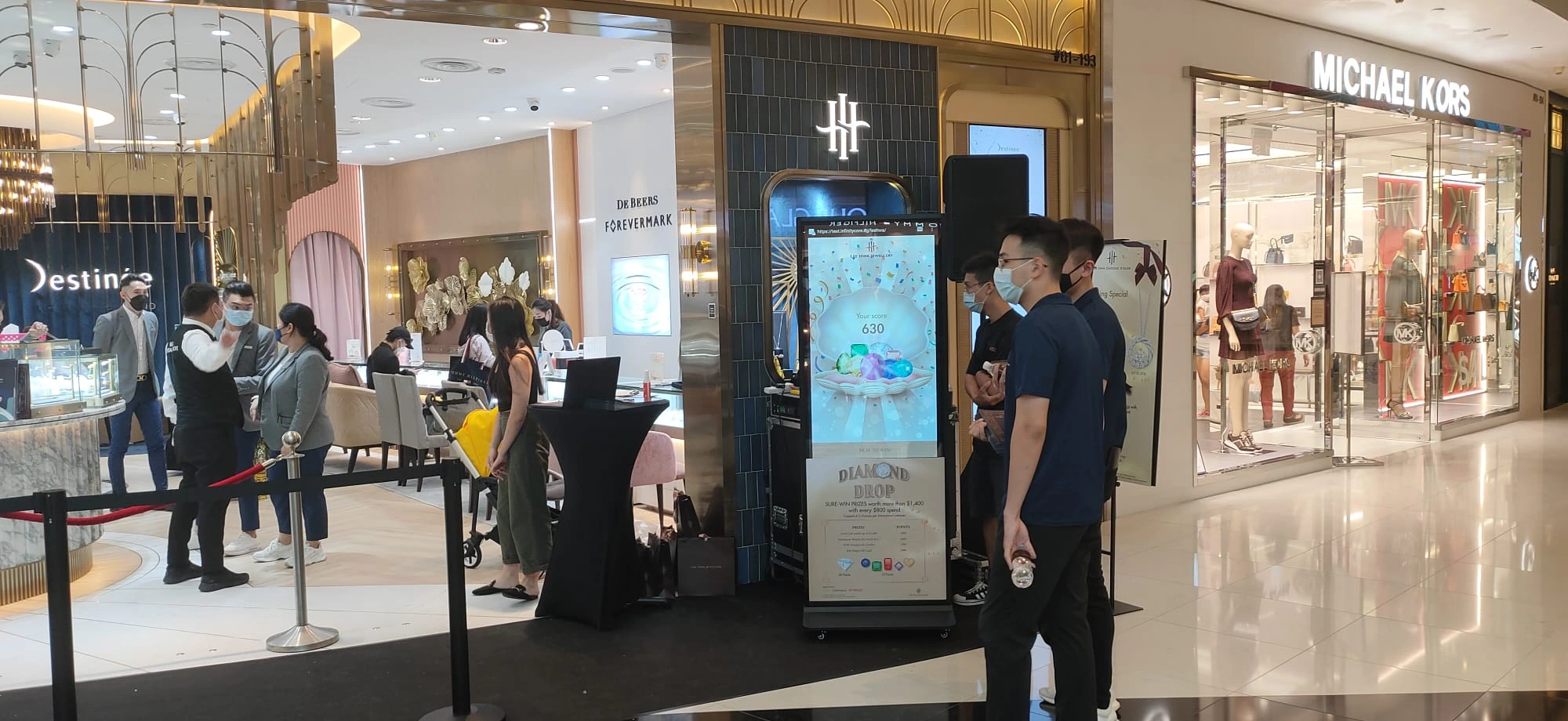
At a jewellery boutique, the first person you need to design for might be walking past while someone else is already playing. They’ve missed the instructions. They can see the screen for a few seconds. What would persuade them to stop for a turn of their own?
Lee Hwa’s Diamond Drop made the invitation visible in the gameplay. Gems fell down a portrait screen at the boutique entrance. The player steered a catcher left and right, collecting gems to build a score. Watch one gem slip past the catcher and you can already picture the move you’d have made. The player’s attention stays on the jewellery theme because the gems are the very things they’re trying to catch.
The end of the round mattered to the retail activation, too. The score came up on screen, giving the boutique team a natural moment to explain the applicable campaign reward. The software handled the game, and the staff had a clear point at which to take over.
For a boutique opening or mall roadshow, test that whole sequence from the aisle. Stand where a shopper would first see the kiosk. Can you tell what’s happening over the player’s shoulder? Then follow the player to the reward handover. If they have to stay in front of the screen to speak to a promoter, the next person in line has nowhere to play. That’s a decision to make on the floor plan, while there’s still room to move the kiosk.
Agilent asked players to pair each service with its purpose
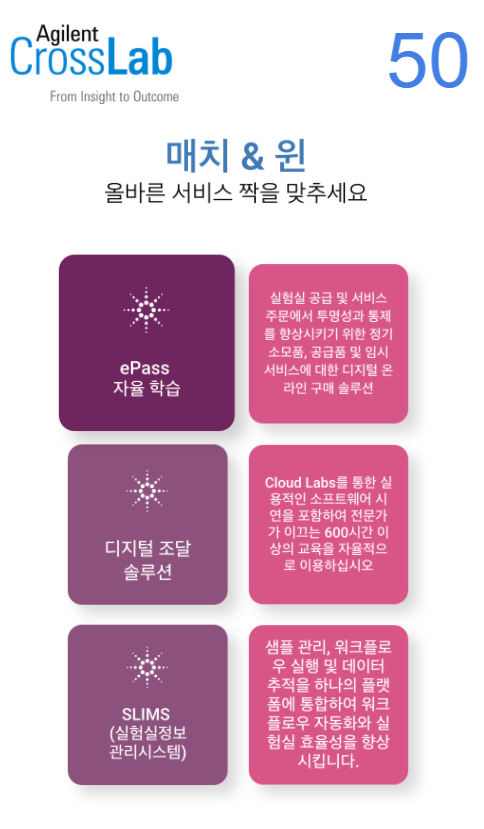
For Agilent, the challenge began with a distinction a buyer needed to understand. A visitor might recognise the CrossLab name and still need help choosing among its services. Catching a branded object would give that visitor little practice making the choice they faced after the event.
In Match & Win, players chose English, Korean or Japanese, then tapped a service and the description they thought belonged with it. There were three timed rounds, with feedback between them. At the finish, players could select services of interest and make an enquiry, or skip the form. A companion iPad gave anyone with a further question space to explore the product information.
In this matching game, the work of reading the tiles was also the work of understanding the offer. That has a practical consequence for anyone commissioning a similar trade show activation. Give the proposed pairs to someone outside your product team before you set the timer. If they can give a convincing reason why two services fit the same description, you’ve found a line of copy to fix.
The optional enquiry made sense at this point in the journey. A player had just spent time distinguishing between services and could name the one they wanted to discuss. For a sales team, that’s a more useful opening to a conversation than knowing somebody earned a high score.
Related work
Play one round before you book the screen
You can learn quite a bit about a proposed game with a few sheets of paper and an empty chair. Take the fare quiz. Write the destination and three prices on the front of a card, and the offer on the back. Give the card to someone who missed the campaign briefing. Listen to their reasoning as they pick a fare, then turn it over. A useful question afterwards is “Would you tell a friend about that flight? What would you say?” Their answer will tell you whether the destination and the price stayed together in their mind.
The same rehearsal looks different for a catching game. Mark out the kiosk footprint on the floor and ask one colleague to stand where a player would. Have another approach from the direction of the mall entrance. Can they see the falling object, the catcher and the score around the first person’s shoulder? A beautiful animation can disappear behind a shopper carrying a child. Discovering that with two chairs and a taped rectangle gives you time to change the screen position.
For a service-matching puzzle, lay the names and descriptions on the table. Ask a sales colleague and someone new to the business to pair them independently. When their choices differ, listen for the words that led each person there. A buyer might describe a problem by its symptom while the product team names it by the service that solves it. That difference gives the writer something specific to change before translations and timed rounds enter the picture.
What would you count after the event?
A play count tells the organiser how many rounds started. It leaves open the question you’ll hear at the debrief. Did people understand the offer, join the activity, or find a service they wanted to discuss? Choose a measure while writing the brief so that the team can plan how to collect it. Each of the three formats suggests a different place to look.
For a fare quiz, a promoter could ask a small sample of players which offer they remember as they leave. For a catching game, someone watching from the aisle could tally how often the next shopper steps forward unaided. At a technical exhibition, the sales team could note which service a visitor asks about after a matching round. Those are examples of measures for a future campaign. Each asks the team to observe a real decision, and each gives the client a more useful debrief than a leaderboard alone.
How to decide what belongs in your brief
Choose a quiz when the reveal is the payoff. Scoot had a specific fact to put in front of people. For a similar campaign, brief the team on the offer, the assumption a visitor might bring to it and what they should see immediately after answering. If you want to learn from play, look at which question visitors consistently miss. That may be the offer that needs a clearer explanation elsewhere in the campaign.
Choose a catching game when you want the next person to join in. Lee Hwa had a product theme people could recognise in motion. For your own activation, identify the object worth watching, sketch the view from the queue and decide where the player goes after the score appears. During a trial, watch whether a spectator can step up and start a turn without a staff demonstration.
Choose a matching puzzle when a visitor needs to make a meaningful distinction. Agilent had service names and descriptions that buyers could connect. Bring the actual pairs to the brief, along with the question a sales colleague could ask after a round. If you’re deciding between formats, try explaining the proposed game to that colleague. The format that gives them a natural way to continue the conversation is the one worth prototyping.